


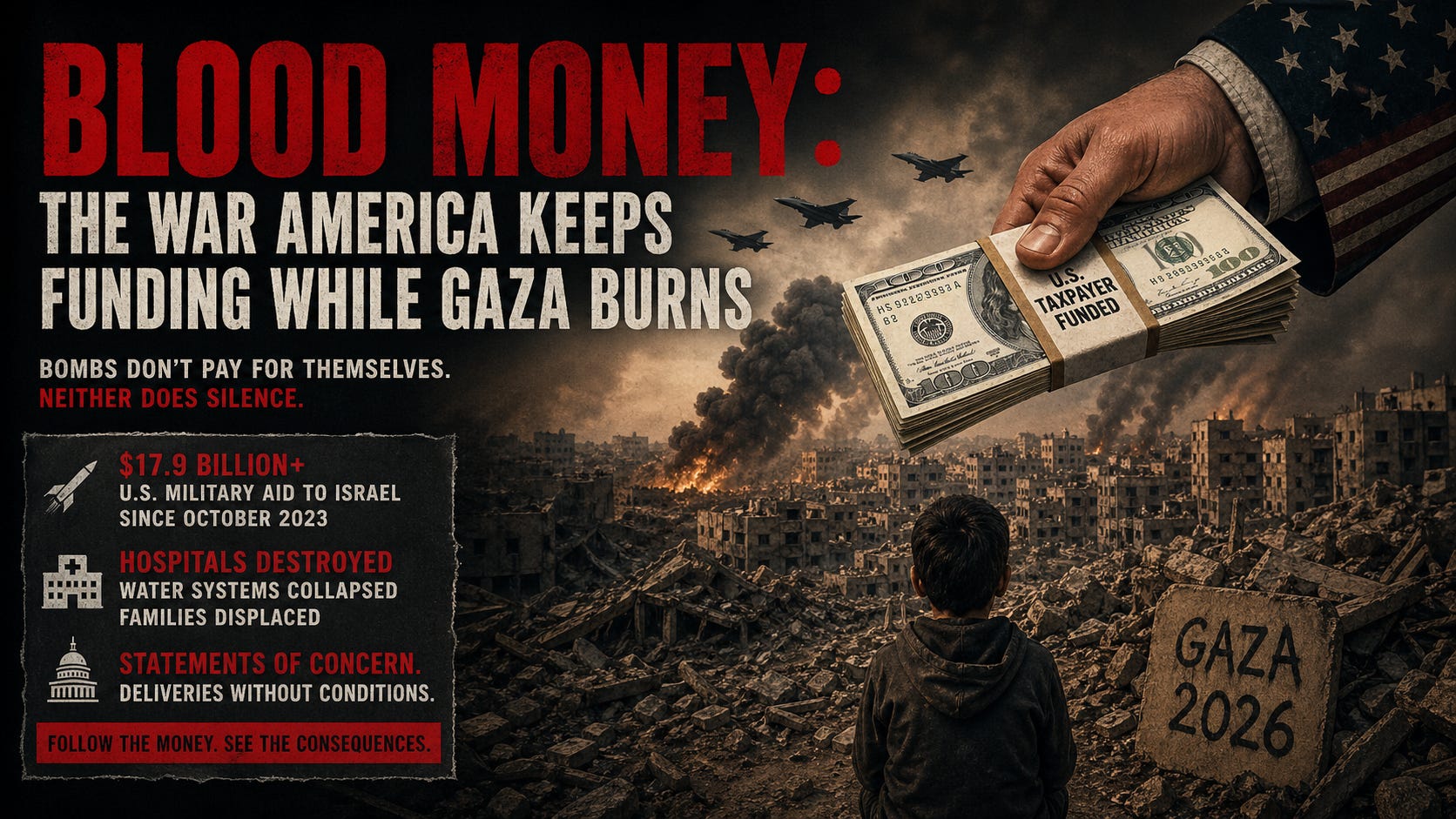
April 2026. The Gaza Strip is being ground down in real time, block by block, system by system, while the world watches in high definition and calls it “complicated.” It’s not complicated. It’s sustained destruction with predictable civilian fallout.
And here’s the part that refuses to stay buried under diplomatic language: the United States is still arming and financing Israel while issuing carefully worded statements about restraint. That split, money on one side, concern on the other, isn’t confusion. It’s a decision.
Homes are gone. Hospitals are degraded. Water and power systems are unreliable or broken. Displacement isn’t a phase; it’s the condition people are living in. Aid moves in starts and stops, never at the scale the situation demands. These aren’t isolated failures. They’re the cumulative result of how this war is being fought and how it’s being supported.
Washington keeps saying it wants limits. But limits don’t come from press briefings. They come from leverage, and the leverage is sitting in appropriations bills, weapons transfers, and diplomatic cover that keep moving forward.
Call it what it is: a war with massive civilian consequences, sustained by a funding stream that hasn’t been meaningfully conditioned. The distance between what’s said and what’s done isn’t a gap. It’s the policy.
The Battlefield as Policy
Israel’s stated objective is the defeat of Hamas after the October 2023 attacks. Hamas operates from dense urban terrain and uses tunnels and civilian cover. Those facts are real and complicate any military campaign.
They don’t nullify the law. International humanitarian law requires distinction and proportionality even in urban warfare. What has unfolded—wide-area bombardment, repeated strikes in populated zones, and cumulative damage to civilian infrastructure—reflects a doctrine that accepts extensive civilian harm as a foreseeable cost. When the same patterns repeat across months, across neighborhoods, across essential services, that’s not a series of accidents. It’s a method.
Civilian Systems Targeted by Outcome
Hospitals, water networks, power generation, and sanitation aren’t just “collateral” when they’re consistently degraded. When a population loses access to clean water, electricity, and medical care at scale, survival itself becomes the battlefield.
The United Nations has warned repeatedly about systemic collapse. Amnesty International and Human Rights Watch have documented strikes and policies that they argue violate the laws of war. Israel contests those claims and points to Hamas’ use of civilian areas. Both statements can be true at once. What matters is the outcome: a civilian environment rendered unlivable for prolonged periods.
Displacement Without Exit
Mass displacement has become a defining feature of the war. Orders to move from one zone to another, followed by strikes in areas deemed “safer,” have produced a cycle of flight with no durable refuge. Crowded encampments in the south and along the coast have absorbed waves of people with minimal infrastructure.
Movement without protection is not protection. When people are told to relocate but the receiving zones lack capacity, services, and sustained access to aid, displacement becomes a rotating emergency. The legal question isn’t whether evacuation can be ordered; it’s whether civilians are given a genuine path to safety. In practice, that path has been narrow and frequently disrupted.
The Aid Bottleneck
Humanitarian access has been inconsistent, politicized, and frequently insufficient relative to need. Aid organizations report delays, inspection backlogs, and constraints on what can enter. Israel cites security screening to prevent diversion to Hamas; aid groups point to volumes that fall short of minimum requirements.
The result is measurable: shortages of food, fuel, and medicine that track not with a single incident but with a sustained pattern of restricted flow. When the pipeline itself becomes unreliable, the humanitarian response can’t scale to the crisis it’s meant to address.
Washington’s Open Spigot
The United States remains the principal external supplier of military assistance to Israel, rooted in long-term agreements and supplemented by emergency appropriations after October 2023. The argument from Washington centers on deterrence, alliance commitments, and regional balance.
Support is not just financial. It includes expedited transfers, intelligence cooperation, and diplomatic shielding at the UN Security Council. Officials pair these actions with public appeals for restraint and humanitarian access. The contradiction is structural: the same government urging limits is enabling capacity.
Conditions That Never Arrive
“Conditioning aid” appears in speeches and press briefings, but binding conditions with enforcement mechanisms have been limited. Existing legal frameworks require that U.S.-supplied weapons be used in accordance with international law, yet the practical bar for suspension remains high and rarely triggered.
The gap between stated standards and applied consequences is where credibility erodes. If conditions exist only as language, not as levers that alter behavior, they function as messaging rather than policy.
Oversight Without Teeth
Oversight bodies have flagged deficiencies in monitoring how U.S. weapons are used. The Government Accountability Office has pointed to gaps in assessment processes and follow-through. Reports are generated; findings are acknowledged; structural change lags.
The enforcement chain is fragmented across agencies, and decisions to suspend or continue aid are ultimately political. That makes accountability contingent, not automatic. Even when concerns are substantiated, the response often defaults to continued engagement rather than restriction.
The Legal Arena and Its Limits
International mechanisms exist to investigate alleged war crimes, including the International Criminal Court. Their reach is constrained by jurisdictional disputes and political pressure, especially when powerful states and their allies are involved.
Legal processes move slowly and require cooperation that is not always forthcoming. In the interim, facts accumulate faster than judgments. The law sets standards; enforcement depends on states willing to prioritize them over strategic alignment.
What Accountability Would Actually Look Like
Accountability is not a slogan. It’s a set of actions that change incentives:
Clear, public conditions tied to continued military assistance, with defined triggers for suspension.
Robust end-use monitoring with transparent reporting and independent verification.
Unimpeded humanitarian access at volumes that meet assessed needs.
Credible investigations of alleged violations with consequences that affect policy, not just paperwork.
None of this requires abandoning an alliance. It requires aligning support with the standards the United States claims to uphold. Without that alignment, the gap between rhetoric and reality becomes the policy itself.