

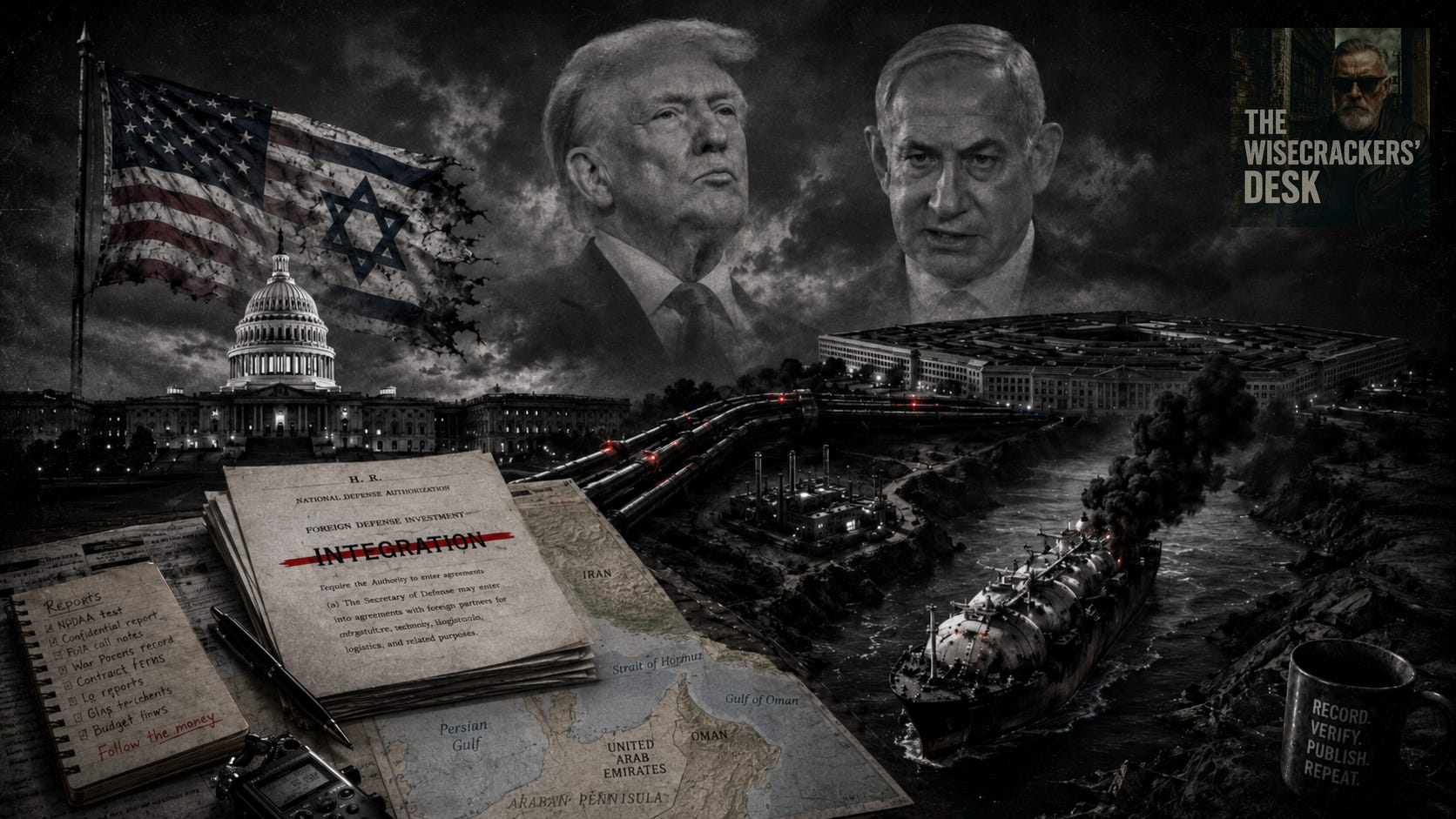
They Scrubbed the Word “Integration.” They Kept the War Machine.
Congress cleaned up the language while preserving the procurement, licensing, manufacturing, and information-sharing machinery underneath.

Congress Is Building the Next War While Pretending to Stop This One
As the war with Iran expands into the Strait of Hormuz and the Red Sea, Congress is considering legislation that would deepen U.S.-Israel cooperation across military research, emerging technology, procurement, licensing, manufacturing, and information sharing. The proposed framework could create strategic and industrial dependencies that future administrations would struggle to dismantle.
Merging With Netanyahu’s War Machine Is a Bad Fucking Idea
Update: By the morning of July 24, the United States had entered a reported thirteenth consecutive night of strikes against Iran. The campaign was no longer confined to missile sites and air defenses. American forces were targeting maritime capabilities while commercial vessels were being redirected, disabled, attacked, or forced to reverse course across Hormuz and the Red Sea. The war had become a fight over who controls the movement of ships, energy, and trade.
By the evening of July 23, 2026, the Middle East war had moved beyond air bases, missile batteries, government compounds, and whatever targets military spokesmen chose to highlight in their daily briefings.
*Reporting and market data current through the morning of July 24, 2026. Maritime attribution remains subject to official investigation.
The War Moves to the Water: Updated night count, vessel interference, rerouting, and current oil prices.
Congress Discovers Its War Powers Again: Updated $37.5 billion cost and supplemental request.
A Foreign-Policy Commitment Disguised as Procurement: Contradiction between open-ended wartime spending and deeper U.S.–Israel industrial integration.
The war had reached the ships.
The Qatari liquefied natural gas carrier Al Rekayyat was struck near the Strait of Hormuz on July 7. A fire broke out near its engine room, and the crew evacuated. The Saudi-flagged supertanker Wedyan was damaged off Oman during the same wave of incidents. Saudi Arabia blamed Iran, although the cause had not been independently established when the first reports appeared. Two weeks later, the Saudi tanker Encelia was hit near Jizan in the Red Sea, setting its bow on fire. Its crew survived. The Houthis claimed responsibility and said they had also attacked a second Saudi tanker, Layla, but that second claim remained unconfirmed. (Internazionale)
These vessels matter for different reasons. Al Rekayyat carried LNG through the world’s most important energy chokepoint. Wedyan showed that supertanker-scale crude movements were exposed. Encelia demonstrated that routing Saudi exports toward the Red Sea did not carry them beyond the reach of the regional war.
Hormuz is the Gulf’s main energy valve. The Red Sea corridor is part of the backup route. Pressure was now building on both.
The United States entered a thirteenth consecutive night of strikes against Iran as oil prices surged and the Houthis threatened Saudi-linked shipping. Combatants issued claims faster than investigators could verify them. Politicians promised escalation, retaliation, victory, restraint, punishment, diplomacy, or some incoherent combination of all six. The one conclusion that did not depend on anybody’s propaganda was brutally clear: a regional war had begun squeezing the arteries that carry global energy and trade. (AP News)
Congress had finally located the emergency brake.
“War powers exercised after the casualties arrive are not a restraint. They are an autopsy.”
On July 23, the House voted 214–208 to direct President Donald Trump to remove American forces from unauthorized hostilities with Iran. Hours later, the Senate rejected a motion to discharge a parallel War Powers resolution by 47–49. The House registered formal opposition. The Senate prevented its measure from reaching the floor. American strikes continued. (U.S. Senate)
One day earlier, the House passed the fiscal year 2027 National Defense Authorization Act by 216–212. Inside that sprawling bill sits a Pentagon structure designed to accelerate U.S.-Israeli military research, procurement, licensing, co-production, and information sharing. The Senate has advanced its own version, including language that openly anticipates the “long-term integration of joint capabilities” between the United States and Israel. (Clerk of the House)
Congress is arguing about how to stop the present war while laying industrial and technological track for the next one.
The War Moves to the Water
The Strait of Hormuz carried an average of about 20 million barrels of petroleum liquids per day in 2024, equal to roughly one-fifth of global consumption. Around 20 percent of worldwide LNG trade also moved through the strait, most of it originating in Qatar. Few alternative routes can absorb more than a fraction of that volume. (EIA)
Saudi Arabia’s East-West pipeline can move crude toward Yanbu on the Red Sea. That route becomes more important whenever Hormuz turns dangerous. It also ends in waters exposed to Houthi missiles and drones.
The strike on Encelia drove that point home. Saudi authorities said an unknown projectile hit the tanker near Jizan, causing a bow fire. The crew was safe, and the ship was secured to prevent environmental damage. The Houthis claimed they had attacked Encelia and Layla using missiles and drones as part of a declared blockade of Saudi shipping. Reuters could confirm the damage to Encelia. The reported strike on Layla remained a Houthi claim. (Reuters)
That difference cannot be blurred for dramatic effect. A vessel can suffer damage before investigators know who fired, what weapon hit it, or whether a combatant’s victory statement matches the evidence.
Shipping companies do not have the luxury of waiting for perfect certainty. Masters alter course. Operators delay departures. Insurers raise war-risk premiums. Cargoes sit at anchor. Tankers that turn around do not need a final intelligence assessment before they begin disrupting supply.
Following the Red Sea attacks, war-risk insurance premiums for some southern routes reportedly jumped from roughly 0.3 percent of a vessel’s value to more than 1 percent, with higher quotes for voyages near Yemeni waters. On a tanker worth tens or hundreds of millions of dollars, that adjustment is not loose change. It changes which routes remain commercially tolerable. (Reuters)
The Hormuz incidents carried an even larger energy threat. Al Rekayyat, loaded with LNG, was hit on its port side and developed a fire near the engine room. The crew evacuated safely, but sources briefed on the incident warned that the ship was at risk of exploding. Qatar held Iran responsible and summoned an Iranian diplomat. Saudi Arabia similarly accused Iran of responsibility for the damage to Wedyan. Iran disputed the broader accusations and argued that vessels using unauthorized routes or interfering with tracking procedures created risks inside the strait. (Internazionale)
The attack itself, the official attribution, and a final independent determination are separate facts. The finished article must keep them separate even when governments refuse to.
The people aboard these vessels work inside floating industrial complexes carrying combustible cargo through waters crowded with military aircraft, naval patrols, missiles, drones, and nervous commanders. Their lives rarely appear in the geopolitical shorthand. They become “crew safe,” “crew evacuated,” or “no casualties reported” at the bottom of an incident notice.
One damaged tanker can be repaired. A sustained campaign against commercial shipping changes the behavior of an entire market.
Revised escalation as of Jul 24, 2026:
The shipping war was tightening from both directions. Iran and aligned forces threatened or attacked vessels near the Gulf’s principal energy outlet. The Houthis declared a blockade against Saudi-linked shipping in the Red Sea. American forces began interfering directly with commercial vessel movements connected to Iranian ports. At least nine tankers reportedly altered course after the Houthi announcement. Commercial traffic was no longer collateral to the war. It had become one of the weapons.
Congress Discovers Its War Powers Again
The Constitution gives Congress the power to declare war, fund the armed forces, and regulate the military. The president commands those forces. The War Powers Resolution of 1973 attempted to stop presidents from converting limited military action into open-ended war without congressional authorization. It requires consultation, notification, and a mechanism through which Congress can direct the withdrawal of forces. (U.S. Senate)
The statute has spent decades being tested, stretched, ignored, and partially hollowed out by presidents from both parties. Congress regularly complains about executive overreach while continuing to fund the operations that made the overreach possible.
The Iran conflict followed that rotten pattern.
The House passed an earlier withdrawal resolution in June. On July 23, it approved another measure directing Trump to remove American forces from hostilities with Iran that Congress had not authorized. The Senate did not vote on final passage of its parallel resolution. Senators voted on whether to discharge S.J. Res. 180 from the Foreign Relations Committee. That motion failed 47–49, stopping the measure before the Senate could debate it on the merits. (U.S. Senate Daily Press)
Precision matters here. “The Senate rejected the resolution” would flatten a procedural vote into a final merits judgment. “Congress ordered the war ended” would be even worse. The House acted alone. The Senate blocked action. No binding congressional directive emerged.
Trump kept bombing.
The House vote still matters. It records opposition to a war Congress did not specifically authorize. It establishes that a majority of representatives were willing to put their names behind withdrawal. It also exposes how little practical control Congress possesses after surrendering authority through years of hesitation, partisan calculation, and fear of being labeled weak.
This failure is not a law-school exercise. American service members fly the aircraft, load the weapons, protect regional bases, and absorb retaliation. Their families live with the consequences of decisions made before Congress can finish arguing over procedure.
Every strike creates another chance for miscalculation. Every retaliatory attack creates pressure for a larger response. Each round gives the White House another reason to insist that withdrawal would now appear weak, dangerous, or premature.
Congress debates whether to close the gate after the military convoy has already driven through it.
Revised cost update July 24, 2026:
The constitutional fight was unfolding alongside an accelerating financial one. Defense Secretary Pete Hegseth told senators that the Iran war had already cost approximately $37.5 billion. The administration was seeking tens of billions more for munitions and operations. Congress still had no unified authorization, no clear endpoint, and no credible explanation for how another enormous supplemental would prevent the conflict from becoming the next permanent war account.
Current high-quality reporting supports approximately $67 billion in additional Pentagon war funding, within a broader package that may approach $87–95 billion depending on which nondefense provisions are included. (The Week)
The Clause Inside the Defense Bill
The House passed H.R. 8800 on July 22. The reported bill contained Section 219, the “United States-Israel Defense Technology Cooperation Initiative.” *Earlier versions numbered the provision Section 224, which explains why both numbers appear in the underlying research.
Merging With a Government Accused of Genocide Is a Bad Fucking Idea
Congress wants to bind American weapons, technology, factories, and military systems more tightly to the Netanyahu government while Gaza lies in ruins and international courts examine allegations of genocide, war crimes, and crimes against humanity. That is not responsible defense policy. It is permanent-war machinery disguised as administrative efficiency. More…
The language does far more than schedule meetings or encourage diplomatic cooperation.
Section 219 directs the secretary of defense to appoint an executive agent responsible for synchronizing bilateral defense-technology activity. That official would identify Israeli-origin or jointly developed technology that could enter American military systems and formal programs of record. The provision covers collaborative research involving government, private industry, and universities. It calls for moving technology into procurement, creating joint ventures, negotiating licensing arrangements, establishing U.S.-based co-production, and developing military information-sharing mechanisms. (Rules Committee)
A bipartisan amendment led by Representatives Thomas Massie and Ro Khanna sought to strike the section. The House Rules record shows the proposal, but it was not made in order for a vote. Representative Anna Paulina Luna submitted a separate amendment to strike the section entirely, which also did not receive floor consideration. Two narrower Luna amendments were made in order: one extending annual reporting for as long as the executive-agent position exists, and another removing the word “integration” from Section 219. (Rules Committee)
The public-relations cleanup is hard to miss.
Remove the troublesome word. Preserve the executive agent. Preserve the procurement pathways. Preserve the joint ventures. Preserve licensing, manufacturing, military systems, data fusion, and information sharing.
Congress scraped “integration” off the label while leaving the machinery underneath.
The Senate version is less embarrassed by its purpose. Section 1217 of S. 4784 establishes a parallel initiative under the FUTURES Act. It covers research, Israeli-origin technologies, procurement, industry partnerships, co-production, training, and information sharing. Its reporting language calls for recommendations concerning authorities needed to promote the “long-term integration of joint capabilities.” (GovInfo)
Neither chamber’s version has become law. The Senate has not passed its full defense bill. Any final legislation would require reconciliation between the chambers, another vote, and presidential action.
That uncertainty does not make the proposal irrelevant. It means the architecture is still contestable.
Congress has not settled every technical detail. It has made the direction visible.
From Laboratory to Battlefield
Defense legislation can bury enormous consequences inside a chain of harmless-sounding nouns.
Research. Testing. Licensing. Production. Procurement. Deployment.
Research creates a capability. Testing determines whether it functions. Licensing decides who may manufacture, modify, or use it. Co-production establishes factories and suppliers. Procurement converts it into a government purchase. A program of record locks it into budgets, maintenance plans, training pipelines, contractor support, and long-term military planning.
Once a system reaches that final stage, removing it becomes expensive, disruptive, and politically dangerous.
The proposed initiative reaches artificial intelligence, autonomous platforms, cyber capabilities, electronic warfare, data fusion, military networks, quantum science, directed energy, and biotechnology. These systems can analyze surveillance feeds, identify patterns, rank threats, disrupt communications, guide weapons, and accelerate targeting decisions.
Supporters have a case that deserves to be presented without caricature.
The United States and Israel already cooperate on Arrow, David’s Sling, and Iron Dome. The Missile Defense Agency lists deployed Arrow programs, David’s Sling development, and Iron Dome co-production among existing joint efforts. Those systems are designed to intercept rockets, missiles, aircraft, and drones. Israeli civilians face those threats. American service members stationed across the region face them too. Technology that stops an incoming missile can save lives. (Missile Defense Agency)
The existing relationship is already enormous. A 2016 memorandum committed the United States to $38 billion in military assistance over ten years, including $33 billion in Foreign Military Financing and $5 billion for missile defense.
That history does not justify every future expansion. It raises the burden on lawmakers to explain where cooperation ends and dependence begins.
A missile-interception partnership does not automatically validate a broad pipeline involving military AI, autonomous weapons, cyber systems, biotechnology, data fusion, and network connectivity. Success in one program cannot serve as a lifetime permission slip for every emerging technology a contractor can pitch.
The Pentagon can terminate a research project. Pulling a system out of a program of record becomes another problem entirely. Personnel may be trained around it. Commanders may rely on it. Contractors may control repairs. Software updates may require proprietary access. Replacement parts may come from a narrow supplier base.
Research becomes procurement. Procurement becomes infrastructure. Infrastructure becomes policy that future governments struggle to reverse.
When Cooperation Becomes Dependency
A country can preserve formal sovereignty while losing practical freedom one contract at a time.
The United States may legally command its armed forces while depending on foreign-owned software, proprietary components, licensing agreements, technical data, or specialized maintenance. Ownership on paper does not guarantee the ability to inspect, modify, repair, or replace a system when the political relationship breaks down.
The proposed legislation does not publicly settle the questions that would define genuine American control.
Would the Pentagon receive complete source code? Who would own jointly developed patents? Could American technicians modify the software without foreign approval? Would U.S. factories possess the technical data needed to manufacture replacement parts? Could access be terminated immediately during a political rupture? Who would control data already copied into a partner system?
Those questions are not details to be cleaned up after passage. They determine whether the United States buys a capability or inherits a dependency.
Co-production creates an equally powerful political trap. American manufacturing can create legitimate jobs, technical expertise, and industrial capacity. Workers are not responsible for the foreign-policy structure built around their paychecks.
Politicians and contractors design the trap.
Once a jointly produced system supports factories across several states, every attempt to restrict the partnership can be reframed as an attack on American workers. A human-rights condition becomes a threat to local employment. A suspension of cooperation becomes a factory closure. A foreign government’s military relationship develops domestic constituencies that can punish any lawmaker willing to challenge it.
“Once the alliance becomes a payroll, accountability starts looking like unemployment.”
The contract produces the dependency. The dependency creates the political defense. The political defense keeps the contract alive.
That cycle can outlast the presidents and prime ministers who created it.
Who Controls the Code, the Data, and the Kill Switch?
The House and Senate proposals refer to data fusion, military networks, joint training, and information-sharing mechanisms.
Those phrases do not prove that Israel would receive unrestricted access to every classified American system. Claims that go that far would outrun the public text and hand supporters an easy factual escape route.
The actual risk is serious enough.
Data fusion combines information from radar, satellites, drones, intelligence reports, sensors, and other sources into a common operational picture. Network cooperation can range from basic compatibility to direct connectivity. Congress has not publicly defined where these initiatives would fall on that spectrum.
Every connection creates another access point. Every vendor brings employees, credentials, software libraries, update channels, and subcontractors. Every jointly developed component widens the perimeter American defenders must secure.
The danger does not require malicious conduct by Israel. Iran, China, Russia, criminal networks, and independent hackers search for weak links wherever they can find them. A compromised contractor account can create as much damage as a hostile intelligence operation. A corrupted update can travel through a trusted supplier. A poisoned data stream can distort threat analysis before the person staring at the screen knows anything went wrong.
For a service member or intelligence analyst, the supply-chain history disappears behind the interface. A track appears hostile. A system assigns priority. An operator must trust that the data is accurate, the software is intact, and the network has not been manipulated.
Congress has not placed a public kill switch in the legislation. The bills do not publicly guarantee complete American source-code access, unilateral disconnection authority, independent cybersecurity audits, or enforceable limits on retaining shared information.
The proposals demand speed. The safeguards remain somebody else’s future problem.
That is reckless as hell.
The Bodies Beneath the Sales Pitch
The legal record surrounding Gaza requires precision.
South Africa filed proceedings against Israel under the Genocide Convention on December 29, 2023. The International Court of Justice imposed provisional measures in January, March, and May 2024. The case remains open. The Court has not issued a final judgment finding Israel responsible for genocide. (International Court of Justice)
On November 21, 2024, the International Criminal Court issued arrest warrants for Benjamin Netanyahu and Yoav Gallant. The judges found reasonable grounds concerning alleged war crimes and crimes against humanity. The warrants remain accusations backed by a judicial finding sufficient for arrest. They are not convictions. (International Criminal Court)
Those distinctions matter. The destruction beneath them matters too.
Military technology is sold through language scrubbed clean of human consequence. Operationally proven. Combat validated. Battlefield tested. Every phrase turns a place where people lived, worked, studied, prayed, and sought medical care into a product demonstration.
The proposed initiative covers systems capable of processing surveillance, identifying targets, combining intelligence, guiding autonomous platforms, and accelerating military decisions. Congress has not publicly established whether technologies used or refined during operations in Gaza could enter American acquisition programs through Section 219 or Section 1217.
That silence cannot be waved away as an implementation issue.
The Government Accountability Office reported in April 2025 that State and Defense Department processes did not fully address the risk that recipients might use American defense articles in human-rights abuses. State received 617 reports of civilian harm between August 2023 and December 2024. Its system did not accept direct reports from outside the U.S. government. As of December 2024, State had completed no investigations into reports it considered credible. (Government Accountability Office)
By April 2025, the backlog had grown to 634 reported cases. Hundreds remained in the earliest review stage. State had designed the process around a two-month assessment target, yet some cases had remained open for nearly a year. Officials told GAO they lacked the staffing and resources to process the volume. (Government Accountability Office)
That is the oversight machinery Congress expects the public to trust while authorizing a larger pipeline.
Israeli civilians deserve protection from rockets, drones, massacres, and hostage-taking. Acknowledging that does not erase Palestinian civilians, Iranian civilians, Yemeni civilians, or American service members. Civilian life does not become disposable because another government can identify a legitimate security threat.
Technology used in a campaign marked by mass civilian harm should not slide into American procurement because a manufacturer describes it as proven.
Congress does not get to call that innovation while ignoring the bodies under the fucking sales pitch.
The Oversight Shield Is Full of Holes
Supporters can point to a thick stack of laws and regulations.
The Arms Export Control Act governs defense transfers. ITAR controls defense articles, services, and technical data. Blue Lantern and Golden Sentry monitor end use. The Leahy laws restrict assistance to foreign security units credibly implicated in gross human-rights violations.
Those mechanisms are real. Their existence does not prove that they work quickly, transparently, or comprehensively.
GAO found that current processes addressed only portions of the risk. Custody monitoring can establish that a weapon remains with the approved recipient. It does not necessarily determine whether that weapon was used unlawfully. Licensing can govern the transfer of technical data without answering how the resulting system harmed civilians. A classified briefing can satisfy a reporting requirement while leaving the public unable to evaluate the result. (Government Accountability Office)
The Defense Department inspector general also completed a dedicated audit of enhanced end-use monitoring in Israel. The existence of that audit alone demonstrates that the monitoring regime cannot be treated as a settled question beyond scrutiny. (DoDIG)
Luna’s reporting amendment is better than allowing oversight to expire on a fixed date. It does not create a sunset for the initiative. It does not require an independent civilian-harm assessment before procurement. It does not give Congress a veto before sensitive information sharing begins. It does not guarantee public contract disclosure or unilateral American termination rights.
A report is not a brake.
A report can become a description of machinery already too expensive, politically connected, and operationally embedded to stop.
Congress should repair the accountability system before widening the pipeline. Instead, lawmakers are considering deeper cooperation while hundreds of civilian-harm reports remain trapped inside a process that government auditors already found inadequate.
A Foreign-Policy Commitment Disguised as Procurement
The record leads to an ugly conclusion.
The war has spread into Hormuz and the Red Sea. Commercial energy vessels have been struck. Insurance rates have risen. Shipping routes have changed. American strikes continue. The House has voted to direct withdrawal from unauthorized hostilities, while the Senate has blocked its parallel measure from advancing.
Congress remains divided over whether the president possesses the authority to continue the war.
Congress is far less hesitant about building a deeper military relationship with Israel.
The House has passed an NDAA containing an executive-agent structure for bilateral defense technology. The Senate has advanced a parallel initiative that openly refers to long-term integration, acquisition programs, fielded systems, industry partnerships, and information sharing.
The legislation does not create a joint military command. It does not hand Israel formal control over American forces. It does not prove unrestricted access to classified networks.
It creates a framework capable of moving Israeli-origin and jointly developed technology into American systems, procurement programs, factories, training structures, and military information channels.
That should alarm anyone who has watched temporary military commitments become permanent Washington infrastructure.
My Judgment as a Veteran, Citizen, and Independent Journalist
Merging more of America’s military-industrial machinery with the Netanyahu government during an expanding regional war is a bad fucking idea.
That judgment is not aimed at Jewish people. It is not aimed at Israeli civilians. It does not deny the horror of October 7, the murder of civilians, the taking of hostages, or the continuing threat from Iranian missiles and Houthi attacks.
My anger is directed at governments, lawmakers, Pentagon officials, lobbyists, and contractors attempting to hardwire a volatile alliance into permanent American infrastructure before the public has seen the terms.
As a veteran, I reject the surrender of American strategic independence to any foreign government. American service members should not inherit proprietary systems, hidden dependencies, or operational obligations that Congress buried inside acquisition language.
As a citizen, I reject a Congress that votes after the bombs fall, demands reports after civilians die, and pretends paperwork equals control.
As a journalist, I reject the sanitizing vocabulary. Joint ventures mean companies. Licensing means ownership and permission. Co-production means factories and political constituencies. Programs of record mean budgets that renew themselves. Information-sharing mechanisms mean access. Deployment means somebody eventually uses the system against a human being.
Congress can still remove the initiative, narrow it, or impose conditions with teeth. It can require a meaningful sunset, independent cybersecurity audits, public contract reporting, complete American technical-data rights, unilateral termination authority, and civilian-harm screening before any technology enters procurement. It can require a separate congressional vote before sensitive operational data flows across national systems.
Once the contracts are signed, the factories are staffed, the software is embedded, and commanders build readiness around the partnership, every attempt to reverse course will carry a higher political and operational price.
That is how an alliance becomes a cage.
The next official House text will show whether lawmakers removed anything more substantial than an inconvenient word. The next Senate action will determine whether “long-term integration” survives. The next maritime incident will reveal whether attacks on Hormuz and Red Sea shipping remain episodic or harden into a sustained two-chokepoint campaign.
The next bill and the next ship under fire will tell us whether Washington intends to contain this war or build the machinery to live inside it.
Additional Reading:
U.S. Seizes Iranian Vessel as Strait of Hormuz Enters Direct Contact Phase
How vessel seizures, Iranian restrictions, military threats, and direct maritime confrontation transformed Hormuz from a pressure point into an active battlefield.Iran War Timeline: February 28 through March
A chronological guide to the opening strikes, leadership attacks, proxy escalation, energy disruption, War Powers challenges, and the widening regional conflict.The Strait of Hormuz Is Under Fire
A deeper examination of tanker attacks, restricted passage, U.S. naval intervention, Iranian retaliation threats, and the economic consequences of turning a global energy artery into a war zone. (See: U.S. Seizes Iranian Vessel as Strait of Hormuz Enters Direct Contact Phase )War, Markets, and a 36-Hour Shock Cycle
This episode breaks down the documented 36-hour sequence in which presidential messaging triggered a market crash and surge during an active war, with institutional analysis confirming volatility driven by contradictory signals.The Impact of Donald Trump’s Messaging on Global Markets During Conflict
Learn how Donald Trump’s statements have influenced market volatility during international tensions. Understand the mechanics behind market reactions and who benefits from these fluctuations. (See above link)Trump’s 36-Hour Market Whiplash During War
On March 22 and 23, 2026, Donald Trump’s public statements triggered a rapid market crash and surge during an active war. Financial data, energy shocks, and institutional analysis show a volatility cycle driven by messaging, not battlefield change.
Iran War — Full Escalation Update
Sunday, March 22, 2026 | as of 6:30 AM EDT | Day 23
A five-day escalation from March 17–22, 2026 pushed the Iran war beyond containment, triggering simultaneous instability across energy, shipping, and nuclear-adjacent systems.
War Crimes, Illegal Orders, and GOP Fractures
U.S. Strike Threat Meets Iranian Retaliation Warning on Energy and WaterAs of March 23, 2026, a U.S. ultimatum and Iranian retaliation threats have placed Gulf energy and water infrastructure at the center of a rapidly escalating conflict.
Blood Money: Washington’s Weapons, Gaza’s Civilian Toll, and Accountability Without Teeth
The United States remains the principal external supplier of military assistance to Israel, rooted in long-term agreements and supplemented by emergency appropriations after October 2023. The argument from Washington centers on deterrence, alliance commitments, and regional balance.
Support is not just financial. It includes expedited transfers, intelligence cooperation, and diplomatic shielding at the UN Security Council. Officials pair these actions with public appeals for restraint and humanitarian access. The contradiction is structural: the same government urging limits is enabling capacity.
Call Representatives
Demand Answers Before the Pipeline Becomes Permanent
Contact your House member and both senators.
Ask them:
Do you support the U.S.-Israel Defense Technology Cooperation Initiative?
Will you remove it or require a meaningful sunset?
Will you require independent cybersecurity and civilian-harm audits?
Will the United States receive complete source-code and technical-data rights?
Can the United States terminate cooperation unilaterally?
Will sensitive military data sharing require a separate congressional vote?
Do not accept a canned response about supporting Israel or protecting American security.
Ask whether America can walk away once the systems, factories, contracts, and military operations depend on the partnership.
That is the question they would rather avoid.
Author’s Note
I approached this investigation as a veteran, citizen, and independent journalist. Those roles overlap, but none of them gives me permission to play loose with facts.
The United States-Israel Defense Technology Cooperation Initiative remains proposed legislation. The House passed its NDAA vehicle, but the Senate has not passed the final measure, and neither version has become law. The initiative does not establish a joint military command. The public text does not prove unrestricted Israeli access to American classified systems.
The International Court of Justice has not issued a final judgment finding Israel responsible for genocide. The International Criminal Court warrants against Benjamin Netanyahu and Yoav Gallant are not convictions. Houthi responsibility for the Encelia strike remains an attributed claim. The reported attack on Layla remains unconfirmed. Saudi Arabia identified Iran as responsible for the damage to Wedyan, but the initial cause was not independently established.
Those distinctions do not dilute the case against this legislation. They keep the case from being derailed by an avoidable factual mistake.
My opposition rests on what the proposals verifiably contain: deeper cooperation across research, testing, acquisition, licensing, co-production, military systems, and information sharing. It rests on documented weaknesses in civilian-harm oversight, an active regional war, and a Congress that continues struggling to exercise its constitutional authority before American forces enter hostilities.
My description of the Netanyahu government’s conduct as genocidal is a moral and political judgment. It is grounded in the destruction of Gaza, the pending Genocide Convention case, the ICC warrants, and the humanitarian record. I separate that judgment from the present legal status because readers deserve to know where judicial findings stop and my conclusion begins.
They also deserve a journalist willing to state that conclusion without hiding behind Pentagon jargon.
Some editorial illustrations/images used by this publication are created with generative AI under human direction. AI does not replace sourcing, verification, or editorial responsibility. Read my full AI-use policy here.