

Trump’s Distraction Industrial Complex
The Epstein files are under court pressure while the White House floods the zone with spectacle, outrage, and institutional vandalism.

Watch the Files, Not the Fireworks
A federal judge ordered DOJ and Acting Attorney General Todd Blanche to release additional unredacted Epstein-related records or explain the redactions by July 2, 2026. While that legal clock ticks, Trump’s presidency is feeding the country a spectacle storm: White House renovations, Freedom 250 pageantry, a UFC birthday bash, the Qatar jet controversy, and war fog.
Flood the Zone, Bury the Files
On November 19, 2025, Donald Trump signed the Epstein Files Transparency Act, a law requiring the Attorney General to release Department of Justice documents and records related to Jeffrey Epstein. On January 30, 2026, DOJ claimed it had published 3.5 million responsive pages. On April 23, 2026, the DOJ Office of Inspector General announced an audit of the department’s process for identifying, redacting, withholding, and releasing Epstein records. Then, on June 26, 2026, U.S. District Judge Emmet Sullivan ordered DOJ and Acting Attorney General Todd Blanche to release additional unredacted Epstein-related records or explain by July 2 why they must stay blacked out, following a lawsuit by journalist and legal analyst Katie Phang.
That is the clock. That is the legal spine. That is where this story begins.
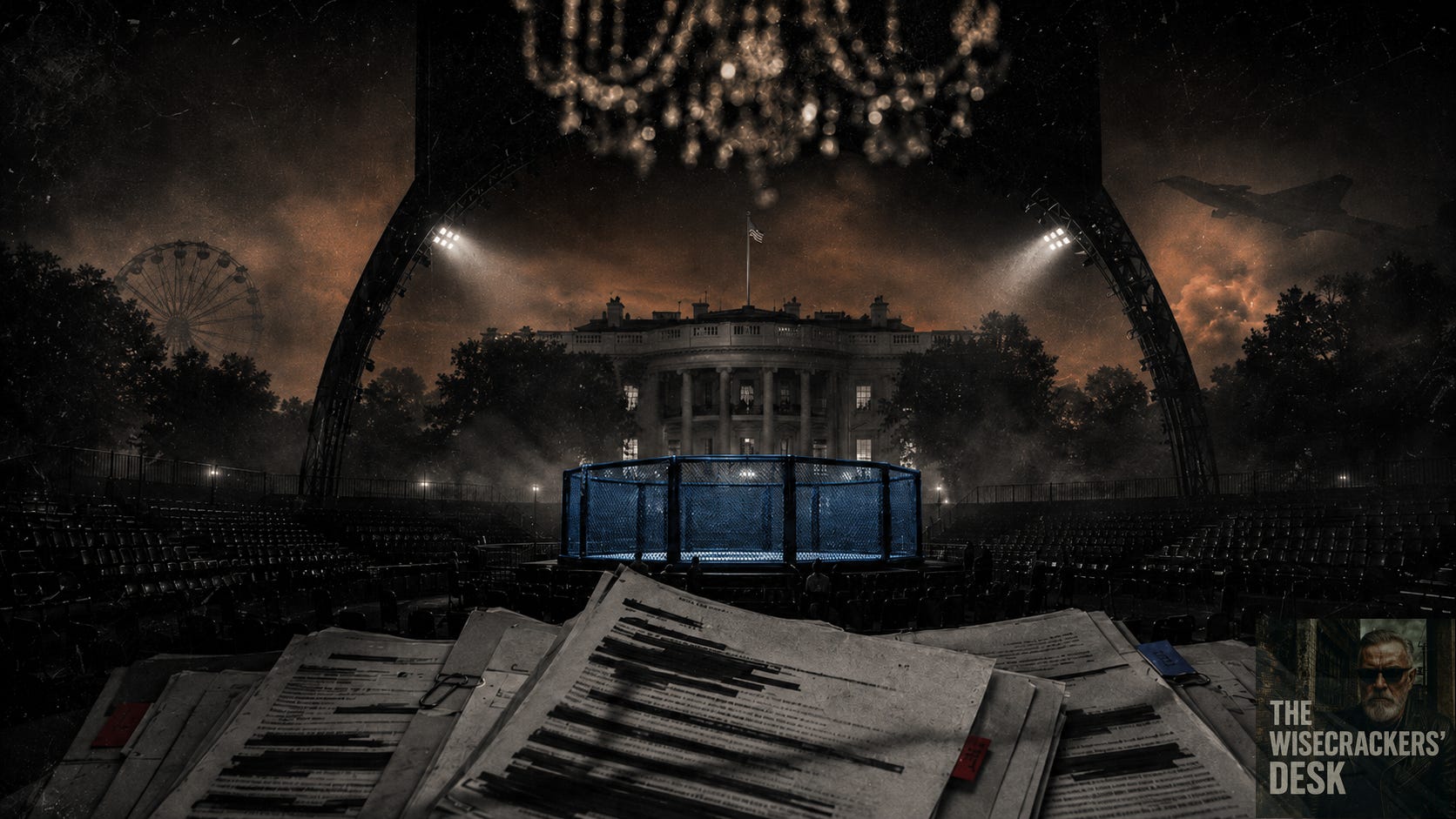
Not with the ballroom. Not with the Ferris wheel. Not with the Qatar jet. Not with the White House UFC cage fight staged like a taxpayer-scented fever dream for a president addicted to spectacle. Those are the smoke. The files are the fire.
Trump and his defenders want the public staring at the noise. The gilded renovations. The East Wing wreckage. The Rose Garden cosplay. The Freedom 250 carnival on the National Mall. The UFC birthday bash on the White House lawn. The foreign-gift jet from Qatar. The war drums in the Middle East. Another rally. Another outrage. Another shiny object thrown into the civic bloodstream like a grenade wrapped in gold foil.
The Epstein files sit underneath all of it, redacted, litigated, audited, delayed, and still not fully explained.
“The files are under court pressure. The spectacles are verified. The intent may be disputed. The function is undeniable.”
This piece does not need a signed memo saying, “Stage a cage fight to bury Epstein.” That is not how attention warfare works. The question is not whether every spectacle was designed for one purpose. The question is whether the spectacle machine functions as cover while DOJ fights over records the public has a statutory right to see.
The files are under court pressure. The spectacles are verified. The intent may be disputed. The function is undeniable.
The Clock Over the Files
Judge Emmet Sullivan’s order gave the government until July 2, 2026. That date matters because it turns this from stale scandal recycling into a live accountability fight. CBS News reported that Sullivan ordered DOJ to either release unredacted versions of several Epstein-related files or explain why it could not do so. The records at issue include emails with blacked-out sender or recipient names, a draft indictment with potential co-conspirator names obscured, and FBI interview notes tied to unverified allegations involving Trump.
That last phrase matters: unverified allegations. Trump denies wrongdoing and has not been charged in connection with Epstein-related allegations. That line belongs in the piece because facts matter, even when rage is justified. Especially when rage is justified.
The point is not to pretend the court order proves Trump committed Epstein-related crimes. The point is that a federal judge has now forced DOJ to answer for redactions and withholdings in a case involving one of the most politically explosive criminal networks in modern American life. Katie Phang sued. Todd Blanche, in his official capacity, became the named defendant. DOJ argued she should have gone through FOIA. Sullivan rejected that dodge for now and ordered action.
DOJ says it plans to appeal. DOJ says it has produced responsive documents. DOJ says some redactions protect personal information or victims’ identities. Fine. Put that on the record. Then release the redaction log. Explain every withholding. Show the legal basis. Stop hiding behind bureaucratic fog while survivors, journalists, lawmakers, and the public are told to trust the same institution now under audit for how it handled the release.
Because this is the part they never want front and center: the Epstein story is not gossip. It is not internet chum. It is not a meme. It is about sexual abuse, institutional failure, elite impunity, and the grotesque possibility that powerful men still benefit from silence.
Compliance Is Not Transparency
DOJ’s January 30 press release claimed compliance. The department said it had published nearly 3.5 million responsive pages under the Epstein Files Transparency Act. That sounds enormous, because it is meant to sound enormous. Millions of pages. Mountains of material. A paper avalanche so big the public is supposed to assume the job is done.
But volume is not the same as transparency. A dump can still be a dodge. A document release can still bury the meaningful material under duplicates, redactions, missing logs, withheld categories, and legal jargon. The public does not need a landfill of paper. The public needs accountability.
That is why the April 23 DOJ Inspector General audit matters. The OIG announced it would review DOJ’s identification, collection, and production of responsive material, along with DOJ guidance and processes for redacting and withholding material under the Act. In plain English, the watchdog is checking how DOJ decided what to show, what to black out, and what to keep back.
That blows a hole through the “nothing to see here” routine.
If DOJ fully complied, then prove it. If redactions protect victims, then explain that with specificity, care, and legal authority. If names were withheld because releasing them would endanger survivors or violate the statute, put that in the log. If names were withheld because they are inconvenient to powerful people, then the country deserves to know that too.
The files are the backbone of this piece because they carry the moral weight. The rest is spectacle. Loud, expensive, humiliating spectacle.
Flood the Zone, Then Act Shocked When Nobody Can Breathe
Trump’s governing style runs on overload. One scandal is manageable. Two scandals are survivable. Ten scandals at once become weather. That is the trick. Flood the zone until accountability feels impossible, then call the exhausted public stupid for losing the thread.
This is not random chaos. It is a strategy of attention theft. Every institution becomes a stage. Every crisis becomes content. Every outrage becomes bait. The goal is not always to convince people Trump is clean. Sometimes the goal is to make the country too tired to keep asking what the hell he is hiding.
That is why the distinction between intent and function matters. We do not have proof that Trump personally ordered each circus act to bury the Epstein files. We do have a documented legal fight over Epstein records happening at the same time Trump’s presidency is feeding America a buffet of spectacle: a demolished East Wing, a gilded ballroom, a politicized State Fair, a White House cage fight, a Qatar jet, and war coverage from the Middle East.
The machine does not need perfect coordination to serve power. It only needs repetition. It only needs saturation. It only needs the next headline to shove the last one off the table.
Trump wants America staring at the chandelier while DOJ keeps explaining why the documents stay blacked out.
The White House as Vanity Construction Site
The White House belongs to the country. It is not Trump’s banquet hall, fight club, private resort annex, or gold-plated therapy project. Yet the symbolism keeps getting dragged through the same gaudy machinery.
The East Wing demolition and ballroom project turned national architecture into a loyalty monument. The Rose Garden, once a public-facing institutional space with history and restraint, became part of the same aesthetic disease: more staging, more polish, more club décor, more Trump stamped onto the republic like a developer’s logo on a cheap condo tower.
This matters because public symbols teach people who power belongs to. When a president treats national spaces as personal property, he is not decorating. He is marking territory.
As a veteran, I do not look at the White House as some sacred object immune from criticism. Hell no. Public buildings should be challenged, protested, investigated, and held to account. But there is a difference between democratic accountability and one man turning the People’s House into a vanity construction site while the public gets told to clap for the gold trim.
The Epstein files remain in legal dispute. DOJ faces a court deadline. OIG is auditing the release process. And while all that happens, the national conversation gets dragged into another round of “look at the ballroom,” “look at the rubble,” “look at the décor,” “look at the spectacle.”
That is how the machine works. It takes public attention, grinds it down, and sells the exhaustion back as normal.
Freedom 250 and the State Fair Flop
Then came Freedom 250, the Trump-created anniversary operation running official events around America’s 250th birthday. NOTUS reported on June 1 that congressionally created America250 faced a $100 million shortfall while Trump-created Freedom 250 had received nearly $80 million in federal grants through the National Park Foundation ecosystem. That wording matters. The $80 million is the Freedom 250 funding ecosystem, not proven as the direct cost of the State Fair alone.
Even with that caveat, the stink is obvious.
Congress created America250 years ago to plan the semiquincentennial. Trump created Freedom 250 later. Suddenly, the official bipartisan birthday commission was reportedly shorted while Trump’s preferred operation got the money stream, the branding, the National Mall stage, the military pageantry, and the political spotlight.
The Great American State Fair opened June 25 on the National Mall and runs through July 10, according to Freedom 250’s own public schedule. AP reported that the fair is run by Freedom 250, that the group’s creation caused tension with America250, and that early crowds came in small numbers. Washingtonian’s opening-day account described sparse attendance, unstaffed spaces, a meager crowd, and disappointed visitors.
That is not a national celebration. That is a forced patriotism pop-up with a Ferris wheel and a political hangover.
The fair matters because it shows how spectacle launders power. Put it on the National Mall. Wrap it in flags. Add flyovers. Add Lee Greenwood. Add the military bands. Add a replica arch. Add pavilions. Add enough patriotic frosting and maybe people will stop asking why the official commission got sidelined, why taxpayer money flowed through a harder-to-track structure, and why the whole thing feels less like America’s birthday than Trump’s campaign merch table with better fencing.
Meanwhile, the Epstein files wait behind black bars.
Bread, Circuses, and a Fucking Octagon
The UFC birthday bash may be the cleanest metaphor Trump has ever handed us. A cage on the White House lawn. A literal cage. On public ground. For the president’s 80th birthday. Wrapped into America 250 branding like a pay-per-view monarchy ritual.
America’s Birthday Became Trump’s Grift Carnival

From Freedom 250 to Fight Night: Trump’s Birthday Pageant Reeks
Time reported that Trump was hosting fighting matches on the South Lawn on Flag Day and his 80th birthday, June 14, with the White House calling it a once-in-a-generation celebration of the American fighting spirit. Court filings and reporting described a lawsuit challenging UFC Freedom 250, alleging improper use of federal property, environmental review failures, and political or financial conflict concerns. The National Desk reported that plaintiffs cited Trump’s friendship with UFC CEO Dana White and alleged a possible personal financial benefit tied to Trump’s reported purchase of TKO Group Holdings stock, UFC’s parent company. The White House called the lawsuit obstructionist and without merit.
“A literal cage on the lawn. Black bars over the files. The metaphor is doing push-ups in the driveway.”
That defense belongs in the record. So does the absurdity.
A president hosting a cage fight on the White House lawn is not civic celebration. It is strongman theater with lighting rigs. It is the federal government bending around one man’s appetite for spectacle. It is patriotic language stapled to a private sports empire. It is what happens when public space gets treated like a casino floor.
The lawsuit may rise or fall on standing, procedural rules, emergency timing, or federal authority. That is the courtroom lane. The public lane is simpler: Americans are watching the White House become an arena while DOJ argues over why Epstein records should stay redacted.
A literal cage on the lawn. Black bars over the files. The metaphor is doing push-ups in the driveway.
The Flying Palace
The Qatar jet belongs in the same machinery because it carries the same message: power gets gifts, access gets polished, ethics get treated like paperwork, and the public gets told to admire the shine.
Associated Press reporting, republished by Fortune, said Trump showed off a newly designated Air Force One on June 19, a formerly Qatari-owned jumbo jet converted into the official U.S. presidential aircraft. The administration accepted the aircraft despite ethics and legal questions about such an expensive gift from a foreign government. Trump defended it as a bridge aircraft until delayed Boeing planes arrive. The Air Force said the aircraft had been modified to meet rigorous security requirements.
Use the careful language here. Do not call it a bribe as a fact. Call it what can be documented: a foreign-gift ethics controversy, a security concern, and a glaring conflict-of-interest alarm bell wrapped in luxury aviation.
Trump reportedly said, “A normal president wouldn’t do this.” On that point, no argument.
A normal president would avoid the appearance of a foreign government handing him a flying palace. A normal president would understand that the presidency is not supposed to look like a luxury concierge desk for monarchy-adjacent favors. A normal president would not need to be told that the optics are radioactive.
But spectacle has its own gravity. The jet becomes another shiny object in the sky, another argument on cable, another outrage cycle, another diversion from the legal question on the ground: what is still blacked out in the Epstein files, and why?
War Fog
War is the ultimate attention weapon. It swallows airtime, scrambles public emotion, moves markets, scares families, and turns domestic accountability into background noise.
The stronger point here is that war coverage functions as a fog machine whether designed that way or exploited after the fact. The Guardian reported on June 26 that U.S. forces carried out strikes on Iranian targets after an Iranian drone attack on a commercial ship near the Strait of Hormuz, and Vice President JD Vance warned that “violence will be met with violence.”
That is not a side story. That is life, death, oil routes, service members, civilians, retaliation risk, and regional catastrophe. As a veteran, I have zero patience for politicians who treat war like lighting design. Bombs are not campaign props. Military force is not a news-cycle cleanser. Service members are not background extras for a man who needs another dramatic frame.
War fog buries everything. It buries budgets. It buries ethics. It buries document fights. It buries survivor stories. It buries the question of why a court had to order DOJ to explain redactions in files Congress told it to release.
That is why this matters. Not because every event has a single secret purpose. Because the system benefits every time Americans are shoved from one emergency to the next before they can finish demanding answers.
The Function Is the Cover
Here is the core argument, stripped clean.
The Epstein Files Transparency Act exists. DOJ claimed compliance. The DOJ Inspector General opened an audit. Katie Phang sued Acting Attorney General Todd Blanche in his official capacity. Judge Emmet Sullivan ordered DOJ to release additional unredacted records or explain by July 2 why they must remain sealed. DOJ says it will appeal. Trump denies wrongdoing and has not been charged in connection with Epstein allegations.
Those are the legal facts.
At the same time, Trump’s presidency has thrown the country into a spectacle storm: East Wing demolition, ballroom branding, Rose Garden club aesthetics, Freedom 250 money fights, a State Fair flop on the National Mall, a UFC cage fight on the White House lawn, a foreign-gift jet from Qatar, and fresh Middle East war coverage.
“Trump wants America staring at the chandelier while DOJ keeps explaining why the documents stay blacked out.”
Those are the public facts.
The inference is the spine of this piece: whether these spectacles were designed as distraction or exploited as distraction, their function is the same. They scatter attention. They exhaust scrutiny. They normalize institutional self-dealing. They make every scandal feel like old news before anyone has finished reading the damn filings.
The country cannot afford to chase every chandelier while the documents stay blacked out. The public should demand the records, the redaction log, the legal basis for each withholding, the identities of protected categories where lawful, and the names of officials who made the decisions.
Release the files. Explain the redactions. Stop turning public institutions into props while survivors and citizens wait for the truth.
July 2 is the next pressure point. Watch what DOJ does when the clock runs out. Watch whether it releases records, appeals harder, dumps explanations, hides behind victim-protection language without specifics, or tries to bury the filing under another wave of Trump spectacle. Watch the headlines that appear around the deadline. Watch the shiny object they throw next.
Author’s Note
I am writing this as an independent journalist, a veteran, and a citizen who is sick to death of watching public institutions get converted into one man’s vanity stage. I do not need every piece of the chaos machine to come with a confession letter to see how it works. The legal record matters. The sourcing matters. The distinction between fact, allegation, and inference matters. That is why this piece does not claim Trump personally created every spectacle to hide Epstein. It argues something more durable and harder to dismiss: the spectacle machine functions as cover, and the files remain the thing powerful people still do not want the public staring at for too long.
The demand is simple. Release what the law requires. Explain what remains redacted. Protect survivors without protecting the powerful. Stop making America chase Ferris wheels, cage fights, gilded rooms, foreign jets, and war drums while the documents stay behind black bars.
Call Representatives CTA
Call your representatives and demand full enforcement of the Epstein Files Transparency Act. Ask whether they support full disclosure, a public redaction log, DOJ accountability, and protection for survivors without protection for powerful names. Keep it simple: release the files, explain the redactions, and stop hiding behind procedural fog.